

Alvernia University and community partners marked a major milestone Wednesday with a ceremonial wall-breaking at the historic American House building in downtown Reading, launching the next phase of the Reading CollegeTowne initiative.
The renovation of the 45,000-square-foot, four-story property at 354 Penn St. is a $23 million project that will transform the former American House into a community-focused hub for healthcare, student learning, workforce development and business incubation.
University leaders, elected officials, students and community organizations gathered for the event, which highlighted the building’s role in expanding coordinated healthcare access while supporting downtown revitalization.
Thomas Minick, vice president for advancement and government affairs at Alvernia, said the milestone represents “a visible step in the transformation of this historic building into a community-centered hub that expands access to health care, strengthens workforce development, and creates experiential learning opportunities for Alvernia University students here in the heart of downtown Reading.”
The American House project is part of Alvernia’s broader CollegeTowne model, which connects education, economic development and community services through partnerships. Alvernia President Glynis A. Fitzgerald said the initiative reflects a long-term commitment to the city.
“When Alvernia first shared our vision to expand into downtown Reading, we spoke about CollegeTowne as more than a project,” Fitzgerald said. “It’s a long-term commitment to Reading, to partnerships, and to progress.”
The renovation will place Berks Community Health Center on the building’s first and second floors, offering primary care alongside wraparound services including mental health support, nutrition and wellness education, financial literacy, social services assistance and coordinated referrals.
Berks Community Health Center President and CEO Mary Kargbo said the downtown location addresses persistent barriers to care and is expected to serve more than 2,000 patients in its first year.
“The project is not just about bricks and mortar,” Kargbo said. “It is about dignity. It is about equity. And it is about investing in the long-term vitality of downtown Reading.”
Plans for the building also include expanded business incubation space through Alvernia’s O’Pake Institute for Economic Development and Entrepreneurship, along with retail and community uses. Among those is Special Blends Café, a client-run operation by the John Paul II Center for Special Learning designed to provide hands-on workforce training.
Principal Kaylee Simcik said the partnership creates opportunities that would otherwise not be possible for students.
“This is an opportunity we simply would not have had the means to create on our own,” Simcik said.
Alvernia officials said the site will support at least 50 clinical learning experiences each year for students across healthcare and social service programs, allowing them to work alongside clinicians and community partners while gaining real-world experience.
Mayor Eddie Morán described the project as a symbol of collaboration and momentum in the city’s revitalization efforts.
“This American House project is the physical representation of what happens when we stop working in silos and start working as one,” Morán said. “We’re not just breaking a wall today, folks. We’re breaking ground on a brighter, healthier future for the City of Reading.”
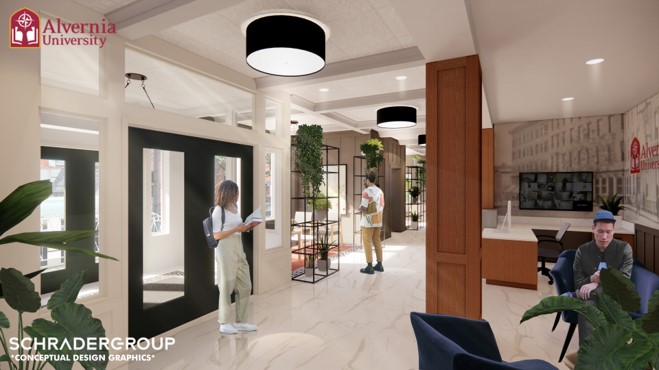
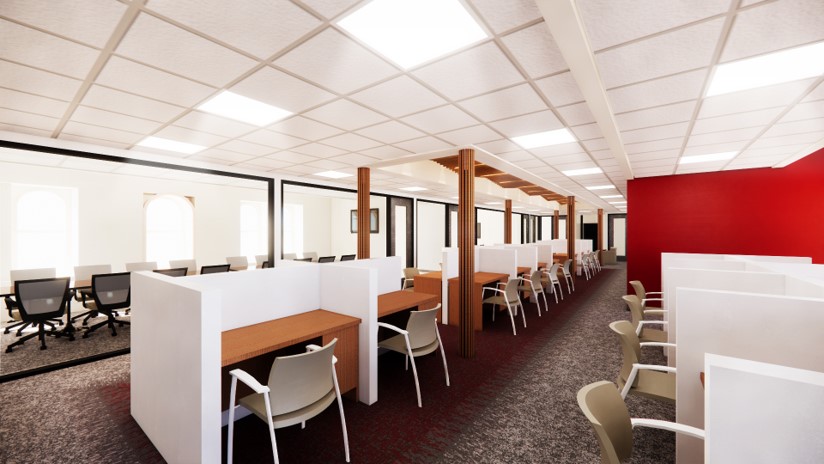
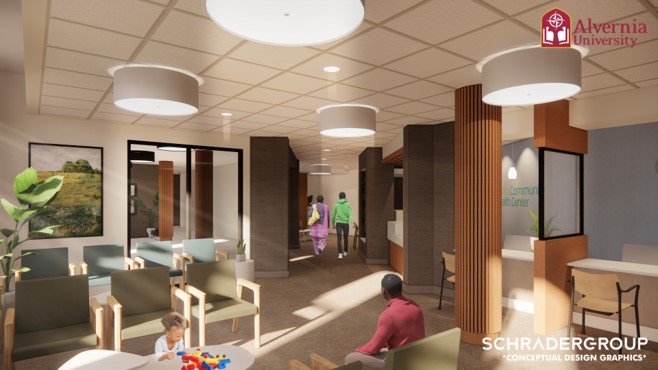
The American House renovation represents the third phase of Reading CollegeTowne. Since launching the initiative in 2019, Alvernia has invested tens of millions of dollars into downtown properties, including the John R. Post Center living and learning facility at 401 Penn St. The university has also expanded the model to Pottsville.
Following remarks, speakers participated in a ceremonial wall-breaking using sledgehammers before tours of the building.
Project timelines shared after the event indicate the café is expected to open around August 2026, the health center by December 2026, and the remainder of the building by fall 2027.